Everyone is a Genius
-But if you judge a fish on its ability to climb a tree it will live its whole life believing that it is stupid-
-ALBERT EINSTEIN-
Pettigala, also known as Pethiyagala, is a hiking area situated in Teldeniya in the Kandy district. It is a moderately tall mountain standing at 760 m, with an altitude variation of 200 m, in the central highlands of Sri Lanka. The Hike to Pettigala is one that is worth the challenge with the mountain range being easily accessible by bus. The path to Pettigala goes through a forest area with many rocky outcrops, opening up to amazing panoramic views of the surrounding areas. It is quite a challenging hike and should be attempted only by the experienced.
Media captionDid the president refuse to be interviewed? Yes, says Mueller.
President Donald Trump's claim that he was "totally exonerated" by special counsel Robert Mueller has been rejected by Mr Mueller in testimony.
Testifying before Congress, Mr Mueller said he had not exonerated the president of obstruction of justice.
Mr Mueller spent two years investigating alleged collusion between the 2016 Trump campaign and Russia.
He concluded that Russia interfered on Mr Trump's behalf but he did not establish a criminal conspiracy.
In all, 35 people and three companies were charged by the special counsel on matters relating both directly and indirectly to alleged Russian interference in the 2016 election. No members of the Trump family were charged.
The special counsel's office ruled that it was unable to charge the president with a crime, but could not exonerate him either. During his two-year investigation into Mr Trump, Mr Mueller rarely appeared in public and even more rarely issued statements.
In a hearing on Wednesday - the first of two consecutive Congressional committee hearings - Mr Mueller repeatedly declined to stray outside of confines of his 448-page report. He generally gave clipped answers or referred committee members back to the text of his findings.
The White House called Mr Mueller's testimony an "epic embarrassment for the Democrats".
'Serious challenge'
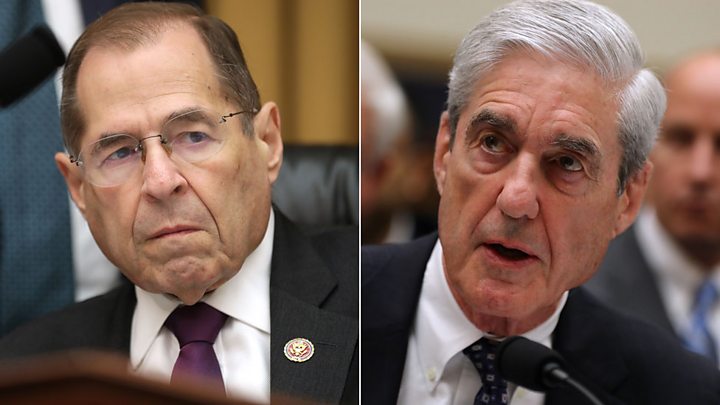
Early on in his testimony, in response to questioning by Democratic committee chair Jerold Nadler, Mr Mueller confirmed that President Trump was incorrect to claim he had been "exonerated" by the special counsel.
Mr Mueller also confirmed that the special counsel team found evidence that the Russian government had attempted to interfere in the 2016 US election and did so with the intention of benefiting then-candidate Mr Trump.
"Over the course of my career I have seen a number of challenges to our democracy. The Russian government's effort to interfere in our election is among the most serious," he said.
Neither the rejection of Mr Trump's claim to have been exonerated nor the confirmation of Russian efforts to benefit Mr Trump were new revelations, but the power of having Mr Mueller state them categorically under oath are likely to be a boost for Democrats.
Media captionThe Mueller report - in 60 seconds
As the questioning went on, Mr Mueller appeared to be uncomfortable at finding himself in the middle of a partisan political battle between Democrat and Republican members - a situation he had made clear he wanted to avoid.
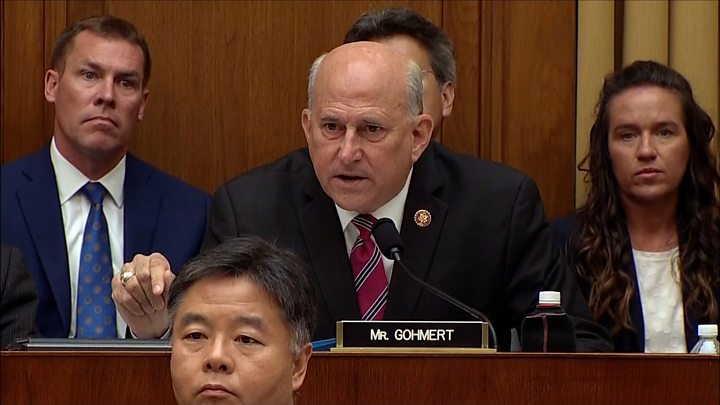
Republican members attacked the former special counsel's decision to neither accuse nor exonerate the president of obstruction of justice. Congressman John Ratcliffe said the decision held the president to a different legal standard than the established presumption of innocence.
Mr Ratcliffe said he agreed that the president should not be above the law, "but he damn sure shouldn't be below the law, which is where volume two of this report puts him".
Mr Mueller began to answer that the investigation into the president was a "unique situation" but was cut off by Mr Ratcliffe. The special counsel report outlines that there is a unique set of circumstances at play, because guidelines issued by the Department of Justice's Office of Legal Counsel (OLC) state that a sitting president cannot be indicted.
Ted Lieu, Democratic congressman for California, asked Mr Mueller: "The reason that you did not indict the president is because of OLC guidance that says you cannot indict a sitting president, correct?"
Mr Mueller replied: "Correct."
He later clarified that he did not intend to say he would have charged Mr Trump but for the OLC guidelines, clarifying that because of the guidelines he had decided not to reach a conclusion.
Media captionRepublican congressman says Mueller hired people "who hated the president"
Democratic members of the committee focused on the detail of some of 10 occasions that the special counsel identified as cases in which the president may have obstructed justice. In particular they focused on the president's alleged attempt to have Mr Mueller fired.
President Trump's then-White House counsel Don McGahn gave extensive evidence to the special counsel investigation, telling Mr Mueller's team under oath that the president had asked him to fire the special counsel, but backed off after he refused.
In May, the New York Times reported that White House officials then asked Mr McGahn at least twice to state publicly that he had never believed the president obstructed justice.
For the president's critics, the McGahn episode represents the clearest and most damning case against the president for obstruction of justice.
Democratic members repeatedly attempted to draw Mr Mueller into a discussion about impeachment, which his report appears to refer to in a passage that reads: "The Constitution requires a process other than the criminal justice system to formally accuse a sitting President of wrongdoing."
But Mr Mueller appeared highly reluctant to confirm that the passage referred to impeachment, or to say whether or not his report was recommending the process, in light of the inability of the criminal justice system to bring charges against Mr Trump.
Mr Mueller said that the special counsel's office repeatedly requested an interview with the president but was refused, and no committee member asked why the president was not issued with a subpoena.
Mr Mueller also denied an allegation which President Trump has repeatedly made - that he was interviewed by the president for the role of FBI director, a job he had held previously for 12 years, the day before he was appointed special counsel. Mr Mueller said he had discussed recruitment for the role with the president but not as a candidate.
Britain, the United States and other nations will meet at a US base to discuss plans to protect ships in the Gulf from Iranian attacks, Sky News understands.
Military representatives from the countries will meet in Florida on Thursday.
The Gulf crisis is the most acute foreign policy challenge facing incoming British prime minister Boris Johnson.
Iran releases new footage of seized tanker
The "force generation" meeting will take place at Central Command in Tampa.
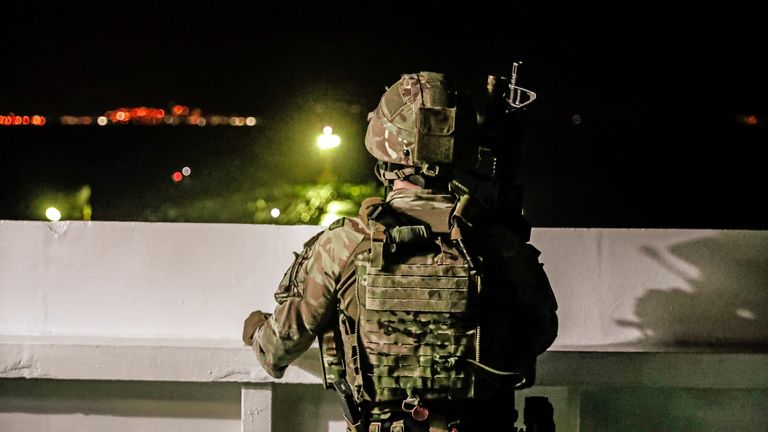
It is part of a US-led push to build a coalition of navies to escort commercial tankers through the Strait of Hormuz and other key waterways in the Middle East as well as to provide increased surveillance, according to two Whitehall sources.
Advertisement
Countries taking part may offer a sense of what warships, surveillance aircraft and personnel they would be able to contribute.
It is not clear how a plan announced by Foreign Secretary Jeremy Hunt for a European-led maritime protection force will fit with the US initiative, which is called Operation Sentinel.
Mr Hunt told parliament on Monday the European force would be separate to the US coalition but he hoped it would be complementary.
The two Whitehall sources told Sky News they are not sure how viable a bespoke European naval force would be and that the only nation with the capability to lead a coalition of this nature is the United States.
Image:The Stena Impero was seized by Iranian authorities. Pic: TankerTrackers
"Nobody here sees how" a European-led maritime force can happen, one source said.
"Unless on Thursday, under a US chair, they negotiate enough capability to form a force and pass it to the European Union to command and coordinate.
"But why would they do that? Perhaps to give US continued diplomatic space to continue with Iran rhetoric?"
It is understood that the aim of tomorrow's conference is to bring together as many nations as possible to protect shipping lanes through increased maritime awareness and coordination of activity regardless of flag, ownership, or cargo.
European countries, including Britain, had been reluctant to respond to calls by President Donald Trump in recent weeks to join the US-led mission because US policy on Iran is at odds with Europe after Washington withdrew from a 2015 nuclear deal with Tehran last year.
Britain and its European allies still support the nuclear accord and are concerned that siding with the US on a maritime mission in the Gulf would reduce the deal's chances of survival even further.
At the same time, they agree on the need for increased security for international shipping in the Gulf in the wake of limpet mine attacks on tankers and the seizure by Iran last Friday of a UK-flagged tanker in the Strait of Hormuz.
The thinking behind proposing a European-led force was that it would be easier for European allies to join up as the US would be at arms length.
Image:British-linked ships and tankers need immediate protection
One Whitehall source, however, said while this is a logical argument there aren't "any credible offers coming forward" from the Europeans.
Positive noises have reportedly been made by France, Italy and Denmark but they are not the same as committing warships, aircraft and personnel, a second source said.
Germany said it is talking to the UK about its idea for a naval mission in the Gulf but "it is too early today to talk about the form of possible German support or participation".
For British-linked ships and tankers operating in the Gulf, the need for greater protection is immediate.
The UK government has advised vessels to avoid the Strait of Hormuz since the capture of the Stena Impero tanker and its 23 foreign crew.
But one maritime industry source said there has been no indication as to how long they had to avoid the area or when any kind of official military escort service would be starting.
Shipping companies also have to cope with a significant hike in insurance cover for ships in and around the Straight of Hormuz.
The price for a tanker for seven days' cover has risen to at least $100,000 (£80,020) for seven days compared with $25,000 (£20,005) about six weeks ago, the source said